Simply White vs Chantilly Lace: Which is Actually *Crisp*
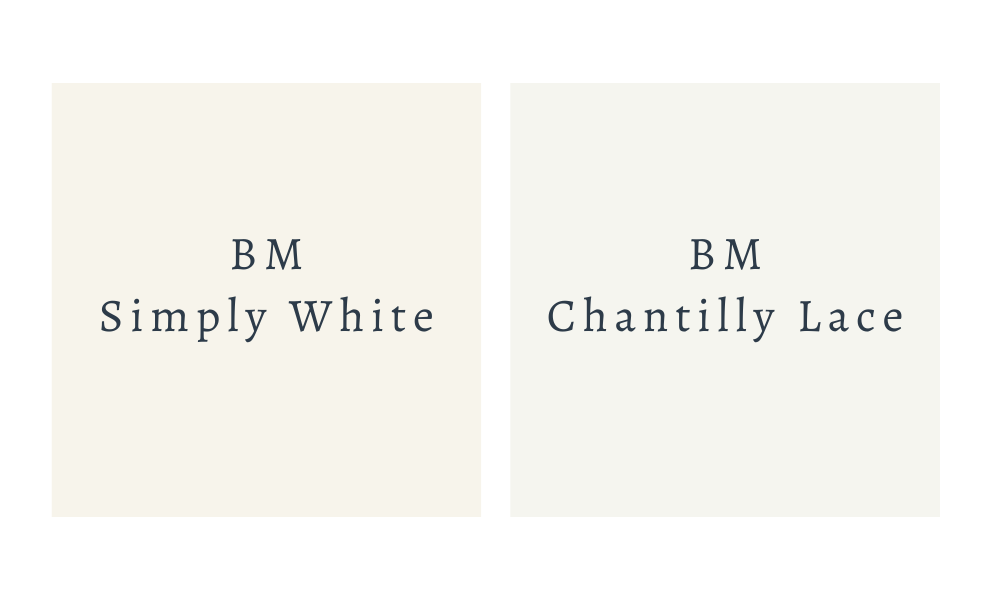
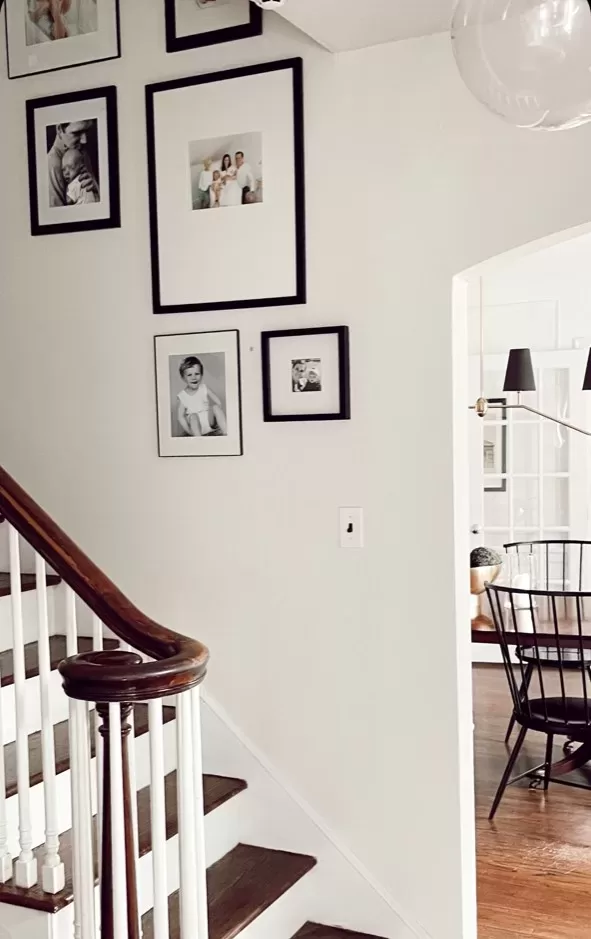
Simply White and Chantilly Lace are two of Benjamin Moore’s most popular white paint colors, and have been for years. It’s easy to see the appeal of each. Simply White, which is the color I chose as my “whole home” paint color for hallways, stairways, and trim, is a gorgeous shade of off white with subtle creamy undertones. Chantilly Lace, on the other hand, is a true white, and is ideal if you’re looking for a clean, bright white.
So which is the best pick for your project? Let’s break it down.
Simply White vs. Chantilly Lace: The Key Differences
Would you like to save this?
Before we get into the details, let’s start with the basics. Both Simply White and Chantilly Lace are considered to be pretty bright whites, and both are designer go-tos. But they’re not the same color — and depending on your space, one is likely going to be a better fit than the other.
Here’s the quick version:
- Simply White (OC-17) is a warm off-white with creamy, yellow-green undertones. It has an LRV of 89.52.
- Chantilly Lace (OC-65) is a bright, crisp white with a more neutral undertone. It has an LRV of 90.4.
So Chantilly Lace is technically brighter than Simply White by a smidge, but the bigger difference isn’t brightness, it’s the undertones. Simply White leans warm and can pull a tad (just a tad, thought) yellow in certain lights. Chantilly Lace is clean and neutral, without any obvious warm or cool pull.
LRV: Simply White vs. Chantilly Lace
As I mentioned above, Simply White has an LRV of 89.52, and Chantilly Lace comes in at 90.4. For reference, LRV stands for Light Reflective Value, and it measures how much light a color reflects. The scale goes from 0 (true black) to 100 (pure white), though no paint color ever actually hits 100, so anything in the 90s is pretty close to true white.
In practice, this difference is pretty minor. Both colors are going to feel bright and light on your walls.
What will make the bigger difference? The undertones.
Tell Me More About the Undertones
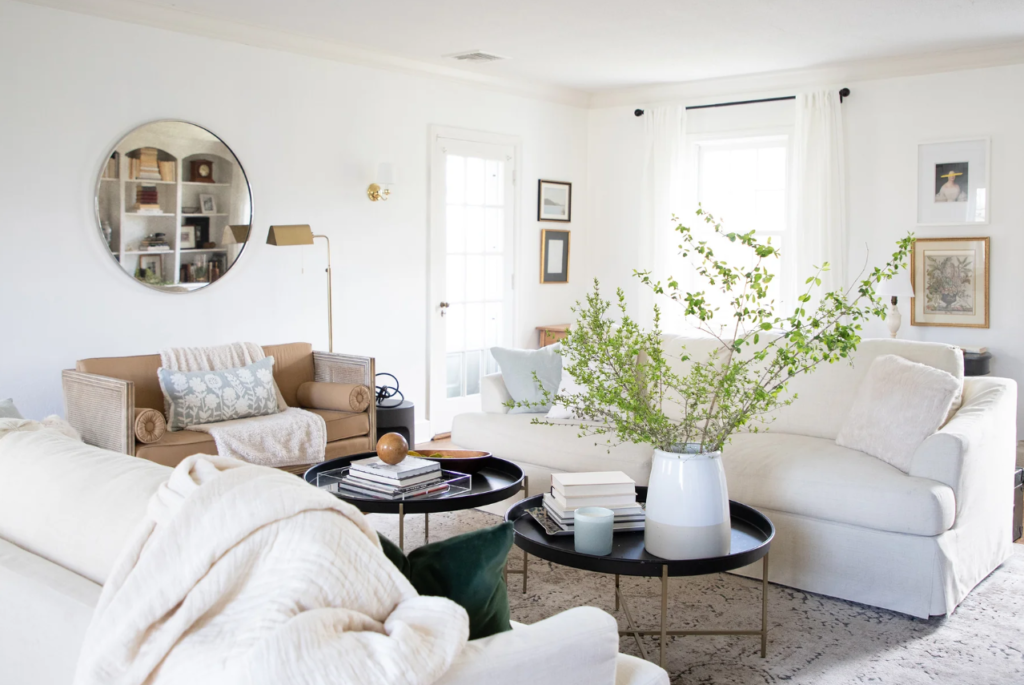
Sure thing! This is where things get interesting, and honestly, where most people go wrong when choosing between these two.
As I mentioned above, Simply White has warm, yellow-green undertones. This is what gives it that soft, lo-fi quality that makes it feel cozy and inviting rather than stark. It’s a white that flatters warm hard finishes—think medium brown wood floors, beige or cream tile, warm-toned granite—and it pairs beautifully with traditional and transitional decor styles.

Chantilly Lace, on the other hand, is often described as a “true white,” and that’s pretty accurate. It doesn’t have an obvious undertone in most lighting conditions. It reads as clean and fresh without feeling cold or sterile, which is part of why it’s become such a go-to for designers. In south-facing rooms, especially around sunset, Chantilly Lace can even feel warm.
So Which One Should You Choose?

Here’s how I’d decide.
Choose Simply White if…
- You love a warm, cozy feel and don’t want anything stark or cold
- Your home has warm hard finishes (wood floors, warm tile, warm-toned countertops or cabinets)
- Your style leans traditional, transitional, coastal, “Nancy Meyers” or farmhouse
- You don’t mind a creamy undertone
Choose Chantilly Lace if…
- You want a clean, bright white without any warmth
- Your home has cooler or more neutral finishes (i.e. cool-toned marble or granite, gray floors, black fixtures or finishes)
- You’re going for a more modern or contemporary look
- You want a white that stays crisp in almost any lighting condition, and you dislike creamy undertones
That said, if you are on the fence, Chantilly Lace can work with warm undertones since it’s so neutral, particularly if your room gets a lot of natural light. Simply White doesn’t generally work with cool-toned finishes.
Can You Use Them Together?
Yes — and actually, this is a combination I think works really well. Because Chantilly Lace is such a clean white, it makes an excellent trim or ceiling color when Simply White is on the walls (or vice versa).